
1. Overview & Sonic Philosophy
The vanBuffelen Delaytor 3000 (v1.0.0) is a component-level software recreation of vintage multi-head magnetic tape echo machines and electromechanical spring reverb tanks. Inspired by iconic 1970s hardware such as the Roland Space Echo RE-201 and classic Frippertronics Sound-on-Sound tape loopers, Delaytor captures the drifting, warm, saturated, and gloriously unruly character of physical tape hardware across Linux, Windows, and macOS.
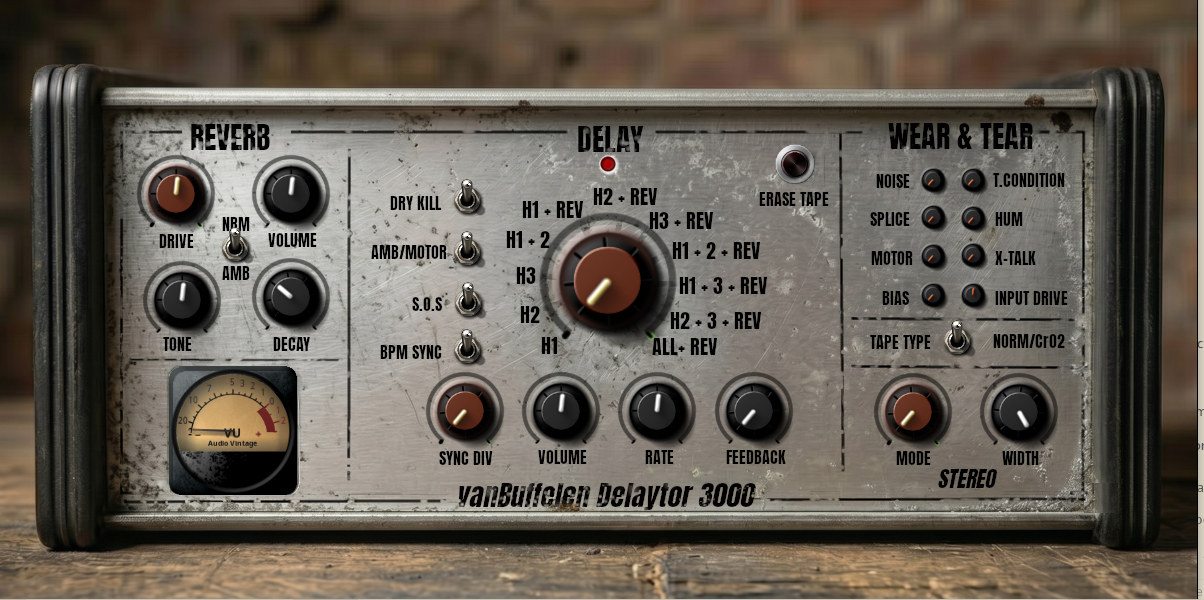
vanBuffelen Delaytor 3000: Full analog front panel featuring Hybrid Spring Reverb, 11-Mode Multi-Head Delay, Function Toggles, Physical On-Tape Wear & Tear, Stereo Matrix, and Ballistic VU Meter.
📼 True Multi-Head Topology
Physical Record Head (95 Hz head bump, HF self-erasure & bias hysteresis) feeding three Hermite playback heads (1x, 2x, 3x) and an 11-mode rotary selector.
🌀 800 ms Motor Inertia
Continuous DC capstan momentum filter produces authentic analog pitch dives, tape flanging, and Doppler sweeps when turning Repeat Rate.
⚡ Zero-Latency Hybrid Springs
Unites real RE-201 spring tank impulse convolution (0 block latency) with 4 helical spring waveguides, 10-stage chirp dispersion, and decays up to ~5.8s.
🎞️ Physical On-Tape Wear
Splices, oxide creases, Wallace spacing loss, and flux-modulated hiss are written onto the moving tape and travel sequentially from Head 1 → 2 → 3.
2. Signal Architecture & DSP Flow
Delaytor 3000 runs at 0 samples of latency (44.1 kHz to 192 kHz) using 64-bit internal Hermite cubic read-head interpolation and zero-latency partitioned convolution:
- Pre-Amp, Input Drive & Bias Ripple: Applies ±24 dB gain, asymmetric hysteresis (2nd harmonics), and multi-harmonic
50/100/150 Hzpower-supply bias ripple with 12 Hz DC blocking. - Magnetic Record Head: Imprints
95 Hzmagnetic head-bump warmth, dynamic high-frequency self-erasure under hot drive, and over 85% of the flux-modulated oxide hiss directly onto the tape. - Audio & Surface Ring Buffers: Dual stereo audio loops plus a physical tape-surface state buffer carry adhesive splices, continuous oxide wear, and creases down the moving tape.
- 4-Oscillator Motor & 3x Hermite Playback Heads: Dual Wow (
0.52 / 1.31 Hz) and Dual Capstan Flutter (6.3 / 11.1 Hz) modulate 4-point cubic Hermite headsH1,H2, andH3with per-head Wallace spacing loss and tension jolts. - Inductive Crosstalk & 11-Mode Combinator: Models adjacent head-to-head ghost bleed (
H1 ↔ H2 ↔ H3) and stereo track bleed (L ↔ R) before energy-normalized multi-head summing. - Feedback & S.O.S. Overdub Loop: Self-limiting
fast_tanhfeedback loop (with 120 Hz rumblestop) plus an optional erase-head bypass loop with a6 kHzdemagnetization filter. - Zero-Latency Hybrid Spring Reverb: Triple-Drive transducer with dynamic bias sag →
240 Hzcabinet body &2.65 kHzcoil peak → 10-stage allpass chirp ladder → RE-201 FFT convolver + 4 helical spring waveguides → complementary allpass stereo decorrelator. - Master Stereo Width & Ballistic VU: 4 spatial modes, Mid/Side width matrix, and 101-frame peak-immune needle ballistics (
+18 dBheadroom).
3. Quick Start Workflows
Dial in four classic studio setups in under a minute:
1. 1970s Kingston Dub Echo
Set Mode to 11 (ALL + REV), Repeat Rate to 4.5 (~250 ms), Intensity to 0.75, Input Drive to +4 dB, Bias to 0.4, and Reverb Volume to 0.45 (Medium Drive).
2. Vintage Surf Spring Slap
Set Mode to 5 (H1 + REV), Repeat Rate to 1.2 (~70 ms), Intensity to 0.2, Reverb Drive to High, Tone to +0.5, Decay to 1.5s, and routing to NRM.
3. Ambient Lo-Fi S.O.S. Loop
Flick S.O.S. UP and AMB/MOTOR to AMB (9.5s loop). Set Motor to 0.45 and T.Condition to 0.50. Layer pads infinitely; tap ERASE TAPE to flush clean.
4. Modern Ping-Pong Stabs
Flick BPM Sync UP, select 1/8 Dotted or 1/4 Triplet, set Stereo Mode to Ping-Pong, Width to 100%, Echo Vol to 0.60, and Feedback to 0.65.
4. Delay Core & The 11 Multi-Head Modes
The center deck houses the three physically spaced playback heads (1x, 2x, and 3x distances from the Record Head), the bakelite 11-mode selector, the ruby Rate pulse lamp, and the transport controls.
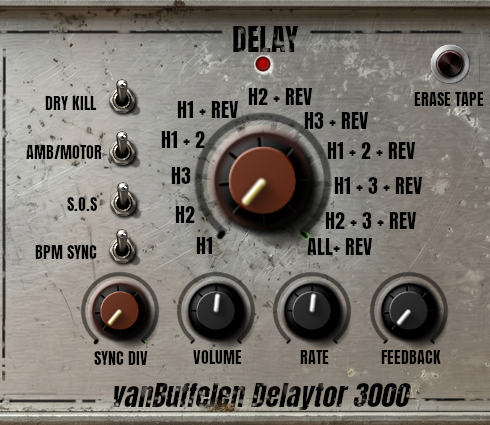
Delay Section: 11-Position Mode rotary switch, tempo-locked ruby Rate LED, Erase Tape momentary switch, and Sync Div / Volume / Rate / Feedback controls.
The 11-Position Mode Rotary Selector
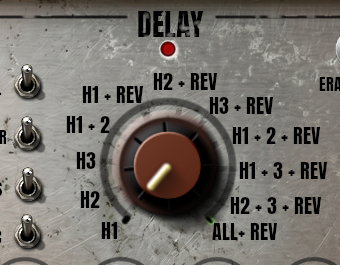
Intelligent multi-head normalization (1.0 / active_heads) keeps output volume balanced when switching across single, dual, and triple head combinations.
| Mode | Dial Label | Active Heads | Spring Reverb? | Musical Character & Use Case |
|---|---|---|---|---|
| 1 | H1 | Head 1 (1x) | No | Tight slapback echo, rockabilly, vocal thickening. |
| 2 | H2 | Head 2 (2x) | No | Medium rhythmic echo, standard guitar or synth solo delay. |
| 3 | H3 | Head 3 (3x) | No | Long, spacious delay repeats for sweeping leads and pads. |
| 4 | H1 + 2 | Heads 1 & 2 | No | Bouncing, galloping dual-tap rhythmic groove. |
| 5 | H1 + REV | Head 1 | YES | Vintage surf guitar slapback with splashy hybrid spring tank. |
| 6 | H2 + REV | Head 2 | YES | Medium rhythmic delay layered over warm spring acoustics. |
| 7 | H3 + REV | Head 3 | YES | Deep, atmospheric space echo for psychedelic soundscapes. |
| 8 | H1 + 2 + REV | Heads 1 & 2 | YES | Interlocking dual-head rhythm floating in a reverberant spring hall. |
| 9 | H2 + 3 + REV | Heads 2 & 3 | YES | Wide polyrhythmic delay cascade with lush spring tail. |
| 10 | H1 + 3 + REV | Heads 1 & 3 | YES | Wide syncopated "gallop" (dotted groove feel) + Reverb. |
| 11 | ALL + REV | Heads 1, 2 & 3 | YES | Dense triple-tap cloud with full hybrid spring reverb. |
800 ms Motor Inertia & Self-Limiting Dub Runaway
Turning RATE (30 ms to 3000 ms) smoothly accelerates or brakes the virtual capstan through an 800 ms physical inertia filter for pitch slides and Doppler warbles. Pushing INTENSITY past 1.0 (up to 1.2) initiates warm, singing analog self-oscillation protected by rational fast_tanh tape saturation, a 120 Hz high-pass filter, and a 10 Hz DC blocker.
5. Function Toggles & Sound-on-Sound (S.O.S.)
Positioned to the left of the delay deck are four rugged hardware toggle switches arranged vertically from top to bottom:
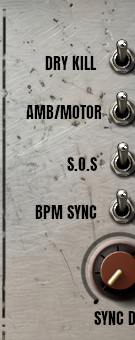
Function Toggles (top to bottom): DRY KILL, AMB/MOTOR, S.O.S., and BPM SYNC above the 9-step SYNC DIV selector.
- DRY KILL (Top Switch): Completely mutes the dry signal path—indispensable on DAW Aux / FX Send buses or for 100% wet ambient washes without comb-filtering.
- AMB / MOTOR (Second Switch): Selects the loop topology when S.O.S. is engaged:
- MOTOR (Motor Sync): Taps audio from Playback Head 3 for tempo-locked rhythmic phrase loops.
- AMB (Fixed Ambient): Engages the full physical
9.5-secondcirculating tape loop for Frippertronics beds and evolving drones.
- S.O.S. (Third Switch — Erase Head Bypass): Disconnects the virtual erase head so incoming audio records over existing tape layers. Each pass runs through a dedicated 6,000 Hz Demagnetization Filter and progressive tape compression so older layers recede warmly into the background.
- BPM SYNC (Bottom Switch): Locks the motor to host DAW tempo across 9 musical subdivisions selected on the SYNC DIV dial (
1/4,1/8,1/16straight, dotted, and triplet).
Erase Tape Momentary Panic Switch

Spring-loaded momentary ERASE TAPE button with brushed aluminum bezel.
Click and hold ERASE TAPE to zero out both stereo tape buffers and flush all internal filter states instantly without clicks or speaker thumps. Releasing the mouse pops the switch back out to resume recording.
6. Hybrid Physical & Convolution Spring Reverb
Updated in v1.0.0, Delaytor unites high-resolution impulse responses captured from a physical 1970s RE-201 tank (running at zero block latency) with 4 physical helical spring waveguides (29.3 ms, 35.1 ms, 41.7 ms, 48.3 ms) and a 10-stage allpass chirp dispersion ladder:
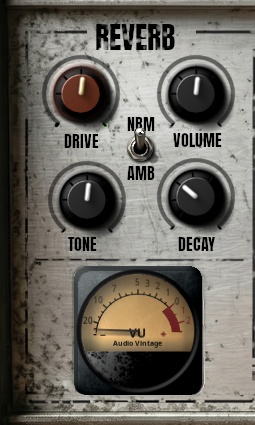
Hybrid Reverb Section: Triple-Drive selector (Low, Med, High), NRM/AMB series-parallel switch, VOLUME, TONE, DECAY, and illuminated ballistic VU Meter.
🎛️ Triple-Drive & Bias Sag
Low (1.15x Class-A headroom), Med (2.25x RE-201 sweet spot), and High (4.20x overdriven coil with deep dynamic supply/grid bias sag and 0.88 chirp drip).
⏱️ ~0.45s to ~5.8s Decay
DECAY (0.1–3.0, ~2.7s at 1.0) asynchronously recompiles the RE-201 IR envelope on a background worker thread while scaling all 4 helical waveguide loops.
🎸 240 Hz Body & 2.65 kHz Coil
TONE shapes an 80–140 Hz rumble cut, warm 240 Hz tank body, electromagnetic 2.65 kHz pickup coil twang, and a 2-pole filter (1.6 kHz dub to 6.2 kHz surf).
🔀 NRM vs AMB Routing
NRM (Parallel): Pre-amp feeds echo and springs separately.
AMB (Series): Every tape echo splashes directly into the spring tank for cavernous trails.
7. Wear & Tear (Physical On-Tape Imperfection Modeling)
Unlike conventional plugins that bolt static LFOs or white noise onto the output bus, Delaytor 3000 writes physical surface wear, adhesive splices, and flux-modulated oxide hiss directly onto the moving tape buffer—so imperfections interact with the Record Head and travel sequentially across Head 1 → Head 2 → Head 3 (coloring even the very first echo at Feedback = 0):
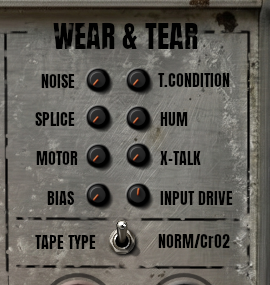
Wear & Tear Panel: 8 precision micro-tweak dials (NOISE, SPLICE, MOTOR, BIAS, T.CONDITION, HUM, X-TALK, INPUT DRIVE) and the NORM / CrO2 oxide switch.
- INPUT DRIVE (
-24 to +24 dB) & BIAS (0.0–1.0): Drives the pre-amp and magnetic Record Head with automatic gain compensation, 95 Hz magnetic head bump, dynamic HF self-erasure, and asymmetric hysteresis for rich 2nd-order even harmonics. - MOTOR (4-Oscillator Transport): Combines Dual Wow LFOs (
0.52 Hz&1.31 Hzreel/pinch-roller eccentricity) with Dual Capstan Flutter LFOs (6.3 Hz&11.1 Hztension shimmer). - SPLICE (Travels Head 1 → 2 → 3): Written onto the tape surface buffer at the Record Head so each head experiences a brief mechanical tension jolt, a Wallace spacing-loss HF/level dip, and a warm bipolar magnetic bias-step thump in exact rhythmic sequence.
- T.CONDITION (Continuous Oxide Shedding): Applies 2-stage non-linear Wallace spacing loss, mechanical tape crinkle & stereo azimuth wander, signal-dependent microscopic asperity modulation noise, and smooth RC-enveloped dropouts traveling H1 → H3.
- NOISE & HUM: Band-limited (
160 Hz – 3.4 kHz) magnetic oxide hiss (>85% recorded directly onto tape, breathing with signal flux) plus multi-harmonic50 / 100 / 150 Hztransformer flux and bridge-rectifier bias ripple. - X-TALK (Head & Track Bleed): Inductive coupling between adjacent playback coils (
H1 ↔ H2 ↔ H3, up to 14% ghost echoes from unselected heads) plus stereo track-to-track bleed (L ↔ R, up to 18%).
Normal (Type I) vs Chrome (Type II) Oxide
- NORM (Type I — Ferric Oxide): Classic 1970s formulation (
3,800 Hzbase oxide roll-off), darker repeats, earlier warm compression, and pronounced 95 Hz head bump. - CrO2 (Type II — Chromium Dioxide): Higher-bias formulation (
10,500 Hzextended bandwidth), crisper transients, and higher magnetic headroom.
8. Master Stereo Processor & Ballistic VU Meter
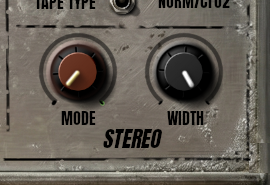
Stereo Section: 4-Way spatial topology selector and continuous Mid/Side Master Width knob.
| Stereo Mode | Technology | Sonic Character & Mono Compatibility |
|---|---|---|
| Dual Mono | 100% Phase Coherent | Strict dead-center mono path for tape, hiss, and spring tank. Zero phase cancellation when summed to mono. |
| Inverted Modulation | 90° Quadrature LFO | Offsets L/R Wow & Flutter phases by 90° (Sine vs Cosine) with a 1.5 ms static azimuth offset for lush stereo chorus without center cancellation. |
| Azimuth Offset | 8 ms Haas Time Shift | Simulates physical head azimuth tilt, introducing an 8 ms interaural time difference for wide 3D spread. |
| Ping-Pong | Cross-Feedback Routing | Alternates repeats across Left and Right (automatically initiates stereo bounce even from pure mono sources). |
True Phase-Decorrelated Stereo Springs & Ballistic VU
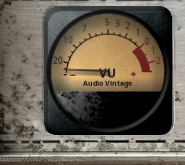
101-frame illuminated ballistic VU needle calibrated to +18 dB headroom with max(|L|, |R|) peak immunity.
In stereo modes 2–4, the hybrid spring tank pairs odd/even left/right helical waveguides with complementary allpass dispersion networks, creating a wide 3D spring field that collapses to mono with zero comb-filtering or hollowness.
9. Mouse & UI Interaction
| Action | Target | Behavior |
|---|---|---|
| Left Click + Vertical Drag | Any Knob | Smooth continuous parameter adjustment. |
| Shift + Click + Drag | Any Knob | Fine Precision Mode (5x higher resolution, 0.002 step sensitivity). |
| Mouse Wheel Scroll | Any Knob | Calibrated stepped parameter increment/decrement. |
| Double Click | Any Knob | Instantly resets parameter to factory default value. |
| Left Click | Toggle Switch | Flips switch state (UP / DOWN) with click-free transition. |
| Click and Hold | Erase Tape Button | Zeroes stereo tape buffers and filter states; springs back to OFF on release. |
10. Pro Sound Design Recipes & Presets
Dial in iconic vintage hardware tones with these six studio presets:
Recipe 1: Kingston Dub Siren & Feedback Wash
Mode 11 (ALL + REV)The legendary Lee 'Scratch' Perry / King Tubby dub echo. Triple heads create a thick cascade while high feedback hovers right at analog self-oscillation. Sweep RATE between 4 and 7 on snare hits for classic dub siren plunges.
Recipe 2: Dick Dale 1963 Surf Guitar Twang
Mode 5 (H1 + REV)Single slapback head coupled with an overdriven hybrid 4-spring waveguide tank. High transducer drive with dynamic bias sag and the 2.65 kHz coil peak bursts with metallic drip on every pick strike.
Recipe 3: Shoegaze / Dream Pop Wall of Shimmer
Mode 8 (H1 + 2 + REV)Interlocking dual-head rhythm feeding in series into an extended hybrid spring cavern. Diffuses distorted guitar chords, vocals, and synth arpeggios into an infinite floating cloud.
Recipe 4: Lo-Fi Boards of Canada Mellotron Tape
Mode 1 (H1)Quad-LFO transport wobble combined with continuous on-tape oxide crinkle, Wallace HF spacing loss, and traveling splice thumps. Turns clean Rhodes pianos and synths into warped 1970s tape loops.
Recipe 5: Space Rock Kosmische Delay
Mode 10 (H1 + 3 + REV)The wide syncopated 'gallop' (Head 1 + Head 3) paired with inductive head-to-head ghost bleed provides the undulating polyrhythmic foundation favored by Pink Floyd and Tangerine Dream.
Recipe 6: Modern EDM Stereo Ping-Pong Stabs
Mode 4 (H1 + 2)Tempo-locked rhythmic stabs bouncing across the stereo panorama with crisp 10.5 kHz Chrome Type II tape response and zero low-end mud.
11. Cross-Platform Installation & FAQ
🐧 Linux (x86_64)
Copy Delaytor-3000.clap to ~/.clap/, Delaytor-3000.vst3 to ~/.vst3/, or launch the standalone ./Delaytor-3000 binary directly.
🪟 Windows (x86_64)
Copy Delaytor-3000.clap to C:\Program Files\Common Files\CLAP\, Delaytor-3000.vst3 to C:\Program Files\Common Files\VST3\, or run Delaytor-3000.exe.
🍎 macOS (Universal2: Apple Silicon & Intel)
Copy Delaytor-3000.component to ~/Library/Audio/Plug-Ins/Components/ (Logic Pro / GarageBand / MainStage) or Delaytor-3000.clap to ~/Library/Audio/Plug-Ins/CLAP/, then run xattr -cr in Terminal once to clear Gatekeeper quarantine.
Q: Why does pitch glide smoothly when I turn Repeat Rate?
Physical tape capstans have mechanical mass and cannot change velocity instantaneously. Delaytor's 800 ms inertia filter models real DC motor acceleration and braking for authentic pitch dives and Doppler sweeps.
Q: How do I silence runaway self-oscillation immediately?
Click and hold the circular ERASE TAPE button in the upper-right of the delay deck. It zeroes both tape ring buffers and resets all filter memories to silence without clicks or pops.
Q: Why do I hear tape hiss or 50 Hz hum when transport is stopped?
The NOISE and HUM dials model continuous oxide noise and transformer/rectifier induction. Dial both down to 0.0 whenever you want pure digital silence at idle.
Q: Can I use Delaytor 3000 purely as a zero-latency vintage Spring Reverb?
Yes! Turn ECHO VOL down to 0.0, select any reverb-enabled mode (Modes 5–11), and use the Hybrid Reverb controls as a dedicated standalone RE-201 / 4-spring waveguide tank.
12. Complete Parameter Automation Reference
Search and filter all 26 host-automatable Delaytor 3000 parameters below:
| ID | Name | Module | Type | Default | Range / Values | Unit | Description |
|---|---|---|---|---|---|---|---|
mode | Mode (Heads + Reverb) | Delay | Stepped Knob | 1 | 1 to 11 | — | Selects 1 of 11 multi-head delay and hybrid spring reverb combinations with automatic energy normalization. |
repeat_rate | Repeat Rate | Delay | Knob | 5.0 | 0.0 to 10.0 (30–3000 ms) | ms | Tape motor delay time with 800 ms mechanical capstan inertia for organic analog pitch sweeps and Doppler glides. |
bpm_sync | BPM Sync | Delay | Toggle | Off | On / Off | — | Locks delay repeat rate directly to host DAW transport project tempo. |
sync_division | Sync Division | Delay | Stepped Knob | 1/4 | 1/4, 1/4d, 1/4t, 1/8, 1/8d, 1/8t, 1/16, 1/16d, 1/16t | — | 9 musical metric note subdivisions for host-synced tempo delays. |
intensity | Intensity (Feedback) | Delay | Knob | 0.0 | 0.0 to 1.2 | — | Feedback loop level. Values above 1.0 initiate self-limiting fast_tanh analog self-oscillation and dub runaway. |
echo_vol | Echo Volume | Delay | Knob | 0.5 | 0.0 to 1.0 | — | Wet delay playback level with built-in +3.5 dB analog makeup boost. |
dry_kill | Dry Kill | Master | Toggle | Off | On / Off | — | Completely mutes dry signal for DAW Aux/Send bus routing or 100% wet ambient drone clouds. |
erase_head_bypass | S.O.S. Mode | Looper | Toggle | Off | On / Off | — | Bypasses tape erase head for infinite sound-on-sound overdubbing with 6 kHz demagnetization loss. |
sos_loop | S.O.S. Loop Length | Looper | Toggle | Ambient | Fixed Ambient / Motor Sync | — | Fixed 9.5-second physical tape loop vs Head 3 tempo-synced rhythmic loop. |
erase_tape | Erase Tape (Panic) | Looper | Momentary | Off | Momentary Push | — | Spring-loaded instant silent wipe: zeroes stereo tape buffers and flushes all filter states. |
reverb_drive | Reverb Drive | Reverb | Stepped Knob | Med | Low / Med / High | — | Selects spring driver saturation (1.15x / 2.25x / 4.20x), dynamic grid/supply bias sag, and chirp drip. |
reverb_volume | Reverb Volume | Reverb | Knob | 0.5 | 0.0 to 1.0 | — | Wet output level of the zero-latency hybrid convolution + 4-spring waveguide tank. |
reverb_decay | Reverb Decay | Reverb | Knob | 1.0 | 0.1 to 3.0 (~0.45s–5.8s) | s | Reshapes RE-201 IR envelope asynchronously and scales 4 helical spring waveguides (~2.7s at 1.0). |
reverb_tone | Reverb Tone | Reverb | Knob | 0.0 | -1.0 to +1.0 | — | Shapes 240 Hz tank body, 2.65 kHz pickup coil resonance, and 2-pole LPF (1.6 kHz dub to 6.2 kHz surf). |
ambient_reverb | Ambient Reverb (Series) | Reverb | Toggle | Off (NRM) | NRM (Parallel) / AMB (Series) | — | Toggles Parallel (NRM) vs Series (AMB) routing where each delay echo splashes directly into the springs. |
input_drive | Input Drive | Wear | Tweak Knob | 0.0 | -24.0 to +24.0 | dB | Pre-amp & Record-Head saturation with 95 Hz magnetic head bump, HF self-erasure, and auto gain comp. |
bias_asymmetry | Bias / Asymmetry | Wear | Tweak Knob | 0.0 | 0.0 to 1.0 | — | Shifts pre-amp, Record-Head & S.O.S. operating point into asymmetric hysteresis for warm 2nd harmonics. |
wow_flutter | Wow & Flutter (Motor) | Wear | Tweak Knob | 0.0 | 0.0 to 1.0 | — | 4 non-synchronous transport oscillators: Dual Wow (0.52 & 1.31 Hz) + Dual Capstan Flutter (6.3 & 11.1 Hz). |
tape_splice | Tape Splice | Wear | Tweak Knob | 0.0 | 0.0 to 1.0 | — | Physical on-tape joint traveling H1 → H2 → H3 with tension jolt, Wallace spacing-loss dip & bias-step thump. |
tape_condition | Tape Condition | Wear | Tweak Knob | 0.0 | 0.0 to 1.0 | — | Continuous on-tape oxide wear, 2-stage Wallace HF loss, crinkle/azimuth wander, asperity noise & dropouts. |
tape_hiss | Tape Hiss (Noise) | Wear | Tweak Knob | 0.0 | 0.0 to 1.0 | — | Band-limited (160 Hz – 3.4 kHz) oxide & flux-modulated hiss (>85% recorded directly onto moving tape). |
preamp_hum | Preamp Hum | Wear | Tweak Knob | 0.0 | 0.0 to 1.0 | — | Multi-harmonic 50 Hz transformer stray flux and 100/150 Hz bridge rectifier bias ripple. |
crosstalk | Crosstalk (X-Talk) | Wear | Tweak Knob | 0.0 | 0.0 to 1.0 | — | Inductive head-to-head ghost bleed (H1 ↔ H2 ↔ H3, up to 14%) and stereo track bleed (L ↔ R, up to 18%). |
tape_type | Tape Type | Wear | Toggle | Normal | NORM (Type I) / CrO2 (Type II) | — | Classic 3.8 kHz ferric oxide with prominent head bump vs 10.5 kHz extended-bandwidth chromium dioxide. |
stereo_mode | Stereo Mode | Stereo | Stepped Knob | Dual Mono | Dual Mono, Inverted Mod, Azimuth, Ping-Pong | — | Spatial topology: phase-coherent mono, 90° quadrature chorus, 8 ms azimuth tilt, or cross-feedback ping-pong. |
stereo_width | Stereo Width | Stereo | Knob | 1.0 | 0.0 to 1.0 (0% to 100%) | % | Continuous Mid/Side stereo width matrix with mathematical mono collapse at 0%. |