
All Plugins
Compressator 1000
The ultimate dynamics toolbox featuring FET, Opto, and Tape saturation in a single interface with flexible routing and external sidechain capabilities.
Compressator
The Compressator 1000 is a versatile dynamics processing channel strip combining three iconic analog hardware topologies into a single, cohesive interface: a fast FET compressor, a smooth Opto compressor, and a lush Magnetic Tape machine.
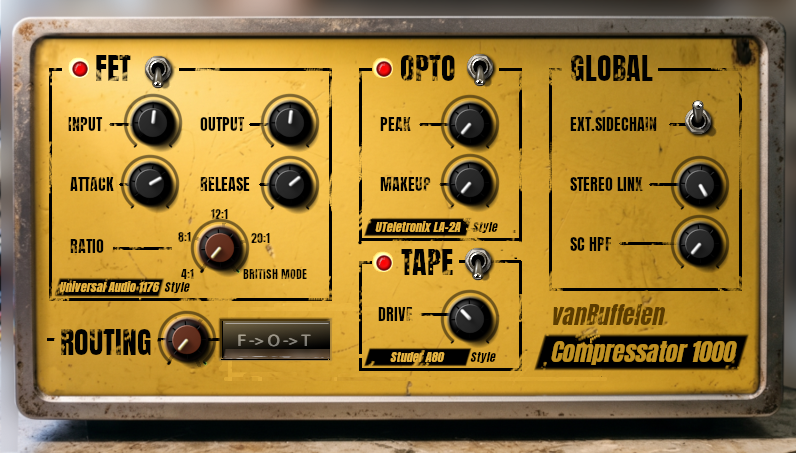
Technical Architecture
At the heart of the Compressator is a highly optimized DSP chain written entirely in Rust. It utilizes internal oversampling to prevent aliasing when applying heavy compression and tape saturation, ensuring pristine audio quality.
Core Modules
- FET Compressor: Modeled after classic 1176-style field-effect transistor designs, this module provides lightning-fast attack times (down to 20µs). It features a Zero-Delay Feedback (ZDF) envelope topology to prevent oscillation at fast attacks, and a dual-stage program-dependent release mimicking analog memory capacitors. It includes standard ratios (4:1, 8:1, 12:1, 20:1) as well as the famous “All Buttons In” mode, which physically misbiases the virtual circuit for a steep 49.0 slope, lagging attack, and severely accelerated primary release—resulting in the famous “pumping” effect.
- Opto Compressor: Accurately emulating the T4B photo-cell ballistics found in LA-2A units. It utilizes a two-stage optical memory model (a 10ms fast attack capacitor and a 50ms slow attack capacitor) so that brief transients don’t trigger long release tails. The release phase features a 60ms initial drop followed by a slow 1.5-second recovery tail. Finally, make-up gain drives a virtual tube amplifier stage featuring an asymmetric rational wave-shaping function to generate rich even-order harmonics.
- Tape Machine: A highly detailed magnetic tape simulation featuring a fractional delay line for mechanical Wow (0.33Hz slow wobble) and Flutter (4.2Hz capstan fluctuations). The saturation stage incorporates Magnetic Hysteresis, meaning the saturation curve slightly lags behind the signal (tape memory), passing through a modified asymmetric
tanhwaveshaper. It finishes with an intrinsic physical tape EQ profile, introducing a +2.5dB resonant head-bump at 65Hz and a smooth 14kHz roll-off typical of 15 IPS tape speed.
Advanced Routing & Control
- Flexible Routing: The signal path is entirely customizable. You can route the signal as
FET -> Opto -> Tape,Opto -> Tape -> FET, or any of the 6 possible permutations. This allows you to catch peaks with the FET before smoothing with the Opto, or vice versa. - External Sidechain: Supports true external sidechain input with a built-in High-Pass Filter (HPF) up to 500Hz, allowing you to compress the signal without triggering pumping from heavy low-end frequencies.
- Stereo Linking: Variable stereo linking (0% to 100%) gives you precise control over the stereo image during heavy gain reduction.
Common Use Cases
- Vocal Chain: Route
Opto -> FET. Use the Opto to gently level the overall performance, and the FET (with a high threshold and fast attack) to catch the aggressive transient peaks. - Drum Bus Crushing: Route
FET -> Tape. Set the FET to “All Buttons In” mode and drive the input. Follow it up with Tape saturation to round off the sharpest transients and add harmonic density. - Bass Guitar: Use the external sidechain HPF to prevent the sub-frequencies from triggering the compressor, keeping the low-end solid while controlling the dynamic midrange.
Built with Rust, NIH-plug, and egui. Tested on Debian Trixie (RT-Kernel), Bitwig Studio 6, and Carla.
×![Full size interface preview]()