
Delaytor 3000
Vintage tape delay and spring reverb emulation inspired by the Roland Space Echo (RE-201), loaded with classic hardware mods, tape wear, and stereo expansions.
Delaytor 3000
The Delaytor 3000 is an authentic multi-head tape delay and spring reverb plugin inspired by the legendary Roland Space Echo (RE-201). Beyond faithfully recreating the sound of physical magnetic tape and motor mechanics, it incorporates the iconic hardware modifications that studio engineers and dub pioneers traditionally performed on vintage Space Echo units.
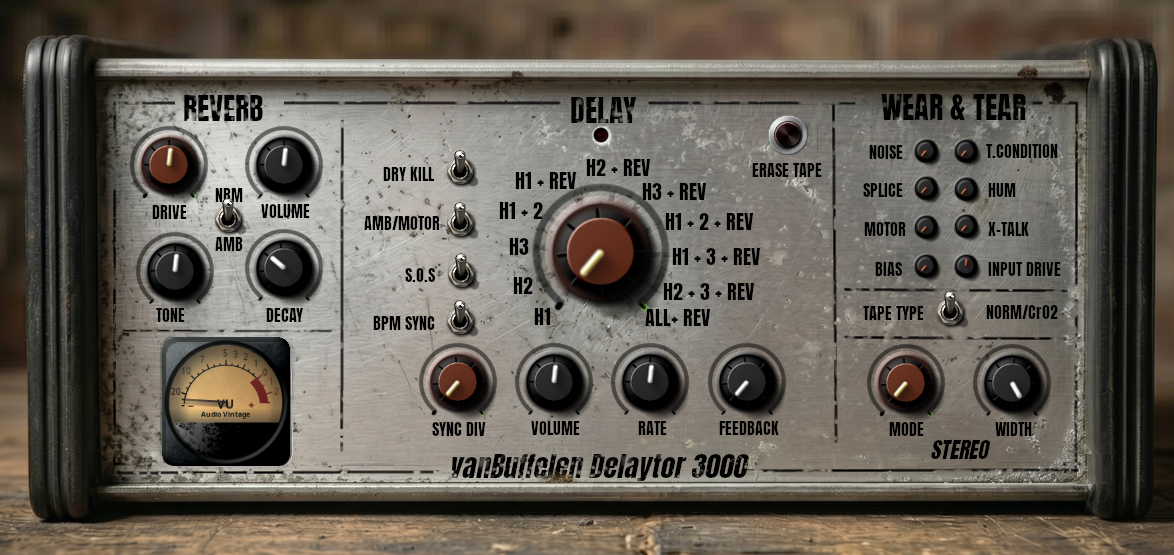
Classic Hardware Mods & Enhancements
Vintage tape delays were frequently modified by technicians to unlock extra creative possibilities. The Delaytor 3000 bakes these classic hardware hacks directly into the interface:
1. Sound-on-Sound (S.O.S.) Erase Head Bypass
In classic studio setups, musicians would install a physical kill switch on the erase head coil.
- Infinite Looping: Enabling Erase Head Bypass stops the unit from wiping old audio, allowing you to layer sound on sound continuously over the tape.
- Dual Loop Modes:
- Fixed Ambient: Uses the entire physical length of the virtual 9.5-second tape loop running through the tape bay.
- Motor Sync: Locks the loop directly to the Head 3 distance for rhythmic phrase building.
- Tape Demagnetization Loss: Each pass through the loop gently loses high frequencies above 6kHz, creating deep, evolving ambient soundscapes.
2. Studio Aux “Dry Kill” Switch
The original RE-201 always passed a portion of the preamp signal. Studio engineers frequently modded the output jack to completely mute the dry signal:
- Dry Kill: Instantly mutes the dry input, making the plugin ready for 100% wet DAW Aux/Send tracks without phase cancellation or comb-filtering.
3. Tape Type Mod (Normal Type I vs. Chrome Type II)
Stock Space Echoes were calibrated strictly for standard ferric tape loops (with a steep high-frequency roll-off around 4kHz).
- Chrome (CrO2) Switch: Simulates modern high-output Chrome tape formulation. It extends the frequency response up to 12kHz, expands dynamic headroom, and delivers cleaner, crisper repeats with less harmonic distortion.
4. Preamp Headroom & Asymmetric Bias
Vintage units had noisy, low-headroom preamps that easily clipped on hot synthesizer signals:
- Modern Headroom Optimization: The input preamp stage is optimized for modern line-level signals and hot synth outputs.
- Bias / Asymmetry Control: Dial in asymmetric saturation to generate lush 2nd-order even harmonics (tube/transformer warmth) alongside tape saturation.
5. Emergency Tape Erase / Buffer Purge
- Erase Tape: A hardware “panic” switch that instantly purges the magnetic tape memory and flushes internal filter states, stopping runaway self-oscillation cleanly without clicks or pops.
Stereo Expansions (Beyond the Original Mono Unit)
The original Roland Space Echo was strictly a mono device. The Delaytor 3000 adds 4 flexible stereo processing algorithms:
- Dual Mono: Pure authentic vintage mono path (ideal for classic dub and guitar chains).
- Azimuth Offset: Simulates physical playback head misalignment by introducing an adjustable micro-delay (up to 8ms) between the left and right channels for a natural, wide acoustic spread.
- Inverted / Quadrature Modulation: Applies a 90° phase shift between the left and right Wow & Flutter LFOs. Because the modulation on both channels never crosses zero at the same time, it generates a lush, wide stereo chorus effect without mono phase cancellation.
- Ping-Pong: Bounces repeats back and forth across the stereo panorama with variable stereo width.
Mechanical Imperfections & “Wear & Tear”
- Capstan Motor Inertia: Features an 800ms physical smoothing glide when changing the Repeat Rate, accurately mimicking the physical spin-up and spin-down inertia of a DC capstan motor.
- Tape Splice Thump: Accurately models the physical tape joint splice, producing a periodic low-frequency thump and brief high-end drop as the glued seam passes across the playback heads.
- Oxide Shedding & Dropouts: The Tape Condition knob introduces randomized micro-dropouts and high-frequency degradation caused by worn, shedding magnetic tape.
- Wow & Flutter: Dual independent phase-stable LFOs (0.5Hz Wow and 2.1Hz Flutter) driven by Hermite interpolation.
- Analog Noise & Mains Hum: Dial in authentic 50Hz mains hum and tape hiss.
Spring Reverb & Mode Selection
- 11 Playback Modes: Select single heads (1, 2, 3), multi-head combinations (1+2, 2+3, 1+2+3), or run parallel/series spring reverb.
- Spring Reverb: Features convolution-modeled physical spring reverb with selectable Reverb Drive (Low, Med, High), decay time, and tone shaping.
- Ambient Mode: Reroutes the spring reverb in series into the delay lines for massive, ethereal reverb tails.
Built with Rust, NIH-plug, and egui. Tested on Debian Trixie (RT-Kernel), Bitwig Studio 6, and Carla.